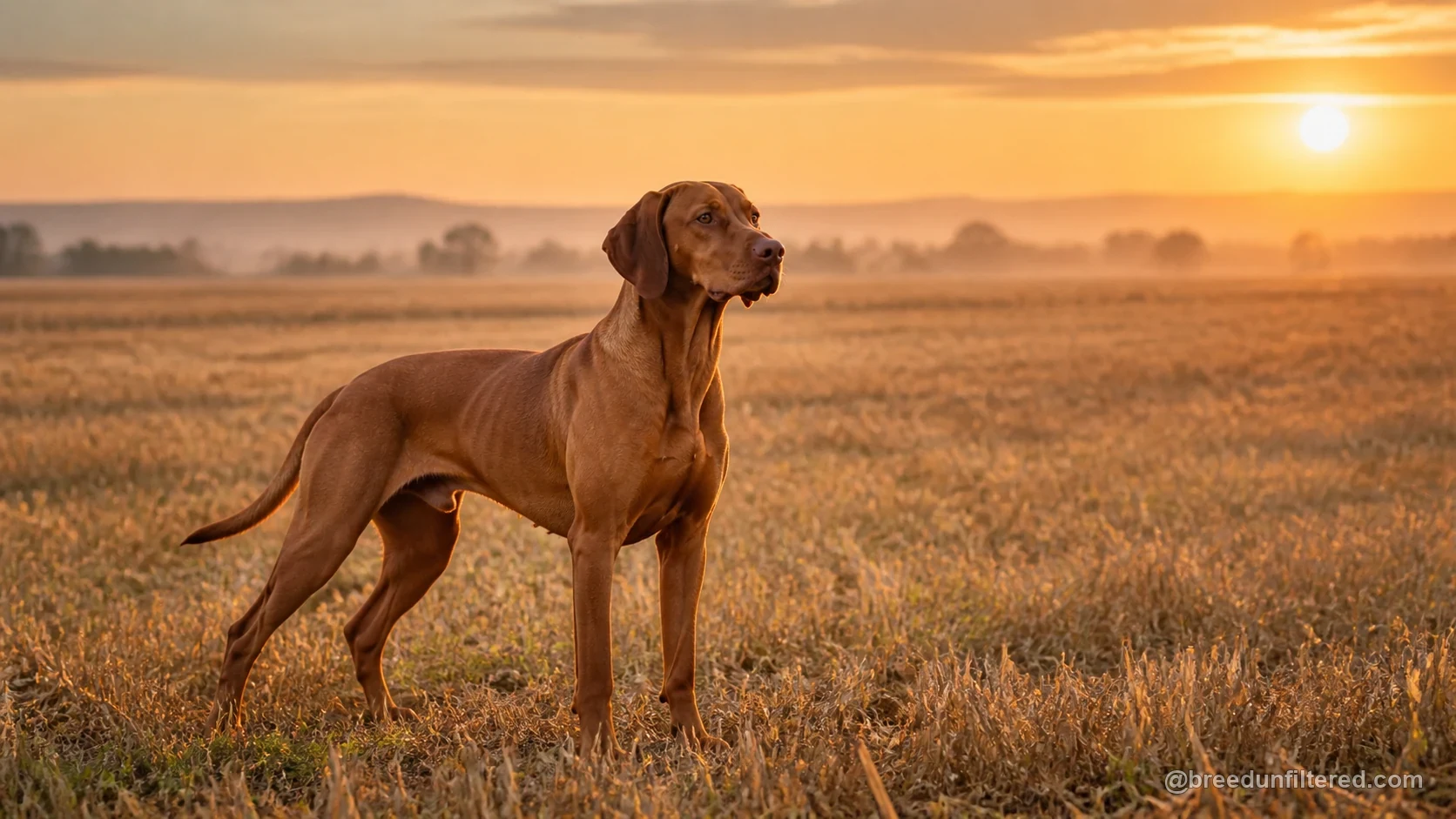
Complete breed guide
Hungarian Short-Haired Pointer (Vizsla) OWNERSHIP GUIDE
The Hungarian Short-Haired Pointer, known worldwide as the Vizsla, is a versatile sporting dog with a distinctive golden-rust coat and a reputation for being closely bonded to its people. Developed in Hungary over centuries, this breed was prized by hunters for its keen nose, steady point, and ability to work in varied terrain. Today, the Vizsla is equally at home in the field and in the family living room, but that versatility comes with specific needs that prospective owners should understand before committing.
This guide offers an evidence-conscious overview of the breed, drawing on official FCI standards and recognised kennel club resources. It covers the Vizsla's origins, temperament, exercise and training requirements, suitability with families and other pets, grooming and health considerations, and the financial and time commitments involved. The goal is to help you decide whether a Vizsla is the right companion for your lifestyle, while acknowledging that every dog is an individual.
Origin and Purpose
The Vizsla's roots trace back to Hungary, where it was developed as a hunting companion for the Magyar nobility. Historical references suggest ancestors of the breed were present in the Carpathian Basin for centuries, with the modern type refined in the 19th and 20th centuries. The FCI standard describes the Vizsla as a 'short-coated hunting dog' used for pointing, retrieving, and trailing, capable of working in field, forest, and water. This heritage is central to understanding the breed's drive and energy.
The breed was recognised by the FCI in 1935 under the name 'Rövid szőrű magyar vizsla' (Hungarian Short-Haired Pointer), with the current standard (No. 57) placing it in Group 7, Pointing Dogs. The Vizsla was bred to work closely with its handler, often ranging at a moderate distance and indicating game with a distinctive point. This close working relationship has shaped a dog that is eager to please and highly responsive to its owner, but also one that thrives on having a job to do.
Temperament and Variation
The Vizsla is often described as affectionate, gentle, and sensitive, forming strong attachments to their families. They are typically friendly and alert, with a tendency to be 'velcro dogs' that prefer to be near their people. However, temperament varies among individuals, and early socialisation and training play a significant role in shaping behaviour. The FCI standard notes that the Vizsla should be 'vivid, intelligent, and amenable to training', but also mentions a 'certain reserve' with strangers, which is not the same as aggression.
There are two coat varieties within the breed: the short-haired Vizsla and the wire-haired Vizsla, which is a separate FCI standard (No. 239). This article focuses on the short-haired type. Within the short-haired variety, there can be differences in energy, drive, and sociability. Some lines may be more intense in the field, while others are more laid-back at home. Prospective owners should meet both parents and, if possible, observe littermates to get a sense of the range.
Exercise and Mental Work
As a sporting breed, the Vizsla has substantial exercise needs. They are not couch potatoes; they require daily physical activity that goes beyond a short walk. Many owners find that a combination of off-lead running in a safe area, play sessions, and structured activities like fetch or agility helps meet their energy needs. However, the exact amount varies by age, health, and individual temperament. It's important to avoid over-exercising puppies, as their joints are still developing.
Mental stimulation is equally crucial. Vizslas are intelligent and can become bored easily, leading to destructive behaviours if under-stimulated. Activities that engage their nose, such as scent work or tracking, can be particularly satisfying. Puzzle toys, obedience training, and interactive games also help. A tired Vizsla is a happy Vizsla, but mental fatigue is just as important as physical exhaustion. Owners should be prepared to invest time in both.
Training and Socialisation
Vizslas are generally eager to please and respond well to positive reinforcement methods. They are sensitive, so harsh corrections can be counterproductive. Early socialisation is essential to help them become well-adjusted adults. Exposing them to a variety of people, animals, environments, and sounds during puppyhood can reduce the likelihood of fearfulness or reactivity. Puppy classes and controlled introductions are often recommended.
Training should be consistent and ongoing. The breed's hunting instincts mean that recall may be challenging when they are on a scent, so reliable recall training is a priority. Many owners use long lines during training to ensure safety. Vizslas can excel in dog sports like obedience, rally, and agility, which provide both mental and physical challenges. However, they may not be the best choice for first-time owners who are not prepared for the commitment to training and exercise.
Family and Other Pets
Vizslas are often good with children, especially when raised with them. They are typically gentle and playful, but like any dog, interactions should be supervised, and children should be taught how to behave around dogs. The breed's high energy may be overwhelming for very young children, so families should consider the dog's need for calm time. Vizslas are also known for being sensitive to family dynamics and may not do well if left alone for long periods.
With other pets, the Vizsla's prey drive can be a factor. They may chase small animals such as cats, rabbits, or birds, though early socialisation can help them coexist with cats. On the other hand, they generally get along well with other dogs, especially if they are properly socialised. However, individual temperaments vary, and some Vizslas may be more territorial or assertive. Introducing a Vizsla into a multi-pet household requires careful management and patience.
Grooming and Health
The short-haired Vizsla has a low-maintenance coat that requires minimal grooming. Weekly brushing with a soft brush or rubber mitt can help remove loose hair and keep the coat shiny. They shed moderately, and more during seasonal changes. Bathing is only needed when necessary, as over-bathing can strip natural oils. Regular ear cleaning, nail trimming, and dental care are also part of routine care.
As with all breeds, the Vizsla is prone to certain health conditions, but not every dog will be affected. Some conditions that have been reported in the breed include hip dysplasia, epilepsy, and certain eye disorders. Responsible breeders screen their breeding stock for these issues. Prospective owners should ask about health clearances and the health history of the parents. Regular veterinary check-ups and a balanced diet contribute to overall well-being, but no guarantees can be made about an individual dog's health.
Costs and Responsibility
Owning a Vizsla involves significant financial and time commitments. The initial cost of a puppy from a reputable breeder can be substantial, and ongoing expenses include high-quality food, routine veterinary care, vaccinations, and preventive medications. Additionally, because Vizslas are active, they may require professional training or dog sports, which add to the cost. Unexpected medical expenses can also arise, so pet insurance is often recommended.
Beyond money, the responsibility of providing adequate exercise, mental stimulation, and companionship is considerable. Vizslas are not suited to being left alone for long hours; they thrive in homes where someone is present most of the day. They also need secure fencing to prevent escapes, as they may follow their nose. Prospective owners should honestly assess their lifestyle, living situation, and ability to meet the breed's needs before bringing a Vizsla home.
Clear answers
FREQUENTLY ASKED QUESTIONS
Are Vizslas good with children?
Vizslas are often good with children, especially when raised with them. They are typically gentle and playful, but their high energy can be overwhelming for very young children. Supervision is always recommended, and children should be taught how to interact respectfully with the dog. Individual temperament varies, so it's important to meet the parents and socialise the puppy early.
How much exercise does a Vizsla need?
Vizslas are a high-energy sporting breed and require substantial daily exercise. This typically includes at least an hour of vigorous activity, such as running, playing fetch, or participating in dog sports. Mental stimulation is equally important to prevent boredom. The exact amount varies by age and individual, and puppies should not be over-exercised to protect their developing joints.
Are Vizslas easy to train?
Vizslas are intelligent and eager to please, which makes them generally trainable with positive reinforcement methods. They respond well to consistency and gentle guidance. However, their hunting instincts can make recall challenging when they are on a scent, so reliable recall training is essential. They are sensitive, so harsh training methods are counterproductive.
Do Vizslas get along with other pets?
Vizslas can get along with other dogs, especially with proper socialisation. However, their prey drive may lead them to chase small animals like cats or rabbits. Early and ongoing socialisation can help them coexist with cats, but individual temperament varies. Introducing a Vizsla into a multi-pet household should be done gradually and under supervision.
What are the main health concerns for Vizslas?
Like all breeds, Vizslas can be prone to certain health conditions, but not every dog will be affected. Some conditions reported in the breed include hip dysplasia, epilepsy, and eye disorders. Responsible breeders screen their breeding stock for these issues. Prospective owners should ask about health clearances and the health history of the parents, and maintain regular veterinary care.
Sources and further reading
15-point breed scorecard
HUNGARIAN SHORT-HAIRED POINTER (VIZSLA) AT A GLANCE
Compare this breedScores describe typical breed tendencies from 1 to 10. They are not a quality ranking or a prediction for an individual dog.
Size and presence6/10
CompactVery large
Physical strength5/10
LightExceptional
Energy level9/10
LowRelentless
Exercise demand10/10
ModestVery demanding
Mental work needed8/10
ModerateDaily job
Trainability9/10
ChallengingExceptional
Everyday manageability5/10
SpecialistStraightforward
First-time owner fit5/10
Poor fitGood fit
Family-life fit8/10
LimitedExcellent
Dog sociability8/10
SelectiveVery social
Prey drive9/10
LowVery high
Guarding tendency3/10
MinimalSerious
Independence4/10
Handler-focusedSelf-directed
Grooming demand2/10
LightHeavy
Apartment fit5/10
Poor fitGood fit