The honest version
WHAT THIS DOG NEEDS
Powerful, independent and deeply territorial when poorly managed. This is not a casual family purchase.
Guardian
A giant guardian with decisions of its own.
The honest version
Powerful, independent and deeply territorial when poorly managed. This is not a casual family purchase.
Watch the episode
Complete breed guide
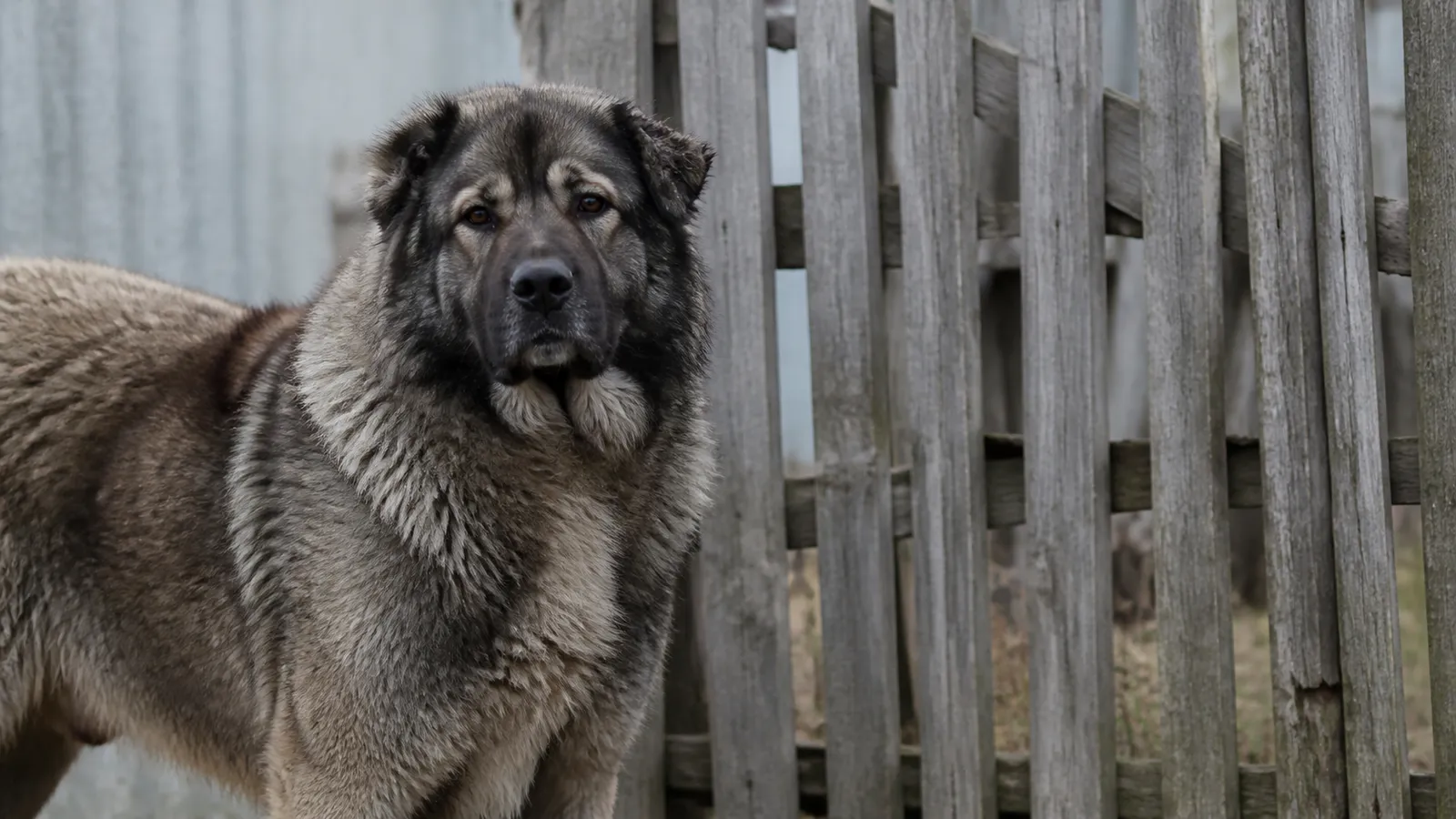
The Caucasian Shepherd Dog is a very large livestock guardian from the Caucasus region and surrounding territories. It was shaped to work with independence, remain alert around territory, and withstand difficult weather. Those traits can be valuable in their original setting but demanding in a modern neighborhood, where delivery workers, visitors, dogs, and maintenance staff regularly cross spaces that a guardian may consider important.
This is not simply a bigger general-purpose companion. Prospective owners need suitable property, strong containment, careful visitor procedures, patient training, and access to experienced veterinary and behavior support. Individuals vary with genetics, upbringing, health, and experience, so no description predicts every dog. Laws and insurance rules also differ internationally; check the exact requirements for residence, travel, and housing before making a commitment.
The FCI describes the breed as originating from ancient dogs of the Caucasus, with historical distribution across mountain and steppe regions. Its work centered on guarding herds, flocks, dwellings, and people from threats. Selection favored physical resilience, keen senses, confidence, and a dense weather-resistant coat. Different landscapes and local traditions contributed to variation in size, coat, and type, which is one reason modern individuals may not all look or behave alike.
A livestock guardian was expected to assess situations without waiting for constant human direction. In a companion home, that independence can appear as slow responses, selective cooperation, or strong concern about boundaries. It should not be turned into a spectacle. Owners do not need to provoke guarding or teach confrontation. The safer modern task is learning to move with a handler, settle away from entrances, accept routine care, and remain securely separated when unfamiliar people must enter.
Many Caucasian Shepherds are calm with familiar people and economical in their movement, yet highly attentive to changes around the home. Affection may be quiet rather than demonstrative. Suspicion, sociability, playfulness, and tolerance for handling differ among individuals, and behavior can shift as a young dog reaches social maturity. A friendly puppy should not be assumed to become an indiscriminately social adult, while reserve should never be used to excuse panic, instability, or uncontrollable behavior.
Ask a breeder or rescue about adult relatives, recovery after surprises, reactions to visitors, veterinary handling, resource use, livestock or pet experience, and behavior away from home. Marketing that celebrates extreme hostility is a serious warning sign. Pain, sensory decline, hormonal disease, and other health issues can influence behavior, so sudden changes need veterinary evaluation. Fear, repeated lunging, guarding conflict, or handling problems call for an appropriately qualified behavior professional who uses humane, evidence-based methods.
The Caucasian Shepherd is not generally an endurance-sport dog, but it still needs daily movement, environmental variety, and opportunities to use its senses. Calm walks in low-traffic places, sniffing, food searches, and controlled exploration can suit an adult better than repetitive ball throwing or forced running. Exercise should support a lean body and sound movement without overheating or overloading joints. Puppies require especially conservative activity while growing, with veterinary advice when needed.
Mental enrichment should build flexibility and cooperation. Short sessions can teach hand targeting, moving away from a gate, resting on a mat, entering a vehicle, wearing a basket muzzle, and accepting touch for care. Rotate chew items and scent-based activities, and provide genuine downtime. Patrolling a fence all day is not healthy enrichment; it can rehearse barking and rushing. Block visual triggers, supervise outdoor time, and bring the dog inside rather than allowing boundary behavior to escalate.
Training must be practical, patient, and reinforced with things the dog values. Physical force or intimidation can damage trust and create conflict with an animal that is both powerful and independently minded. Priorities include leash skills, recall within secured areas, emergency turns, trading items, calm confinement, grooming cooperation, and moving behind a barrier on cue. Equipment should fit securely, and two layers of safety may be sensible in public where permitted by law.
Socialisation is guided exposure, not compulsory interaction. Let a puppy watch people, vehicles, animals, and household activity from enough distance to remain relaxed. Reward attention to the handler and allow withdrawal. Avoid crowded dog parks, forced greetings, and strangers leaning over or embracing the puppy. Continue careful exposure through adolescence. If the dog cannot eat, orient, or recover around a trigger, reduce intensity and seek professional guidance rather than repeating an overwhelming situation.
This breed's size and guarding background require unusually deliberate family routines. Children and dogs need active adult supervision, with gates and separate rooms available before excitement rises. Children should not enter feeding or sleeping areas, take objects, climb on the dog, or answer the door with it present. Elderly or physically vulnerable household members may be knocked over accidentally. Everyone must be able and willing to follow the same containment and visitor plan every day.
Some individuals live well with familiar dogs, cats, or livestock, while others have limited tolerance, especially after maturity. Introductions need space, barriers, capable adults, and no pressure. Separate meals, high-value items, and unsupervised time until long-term patterns are clear. Before visitors or tradespeople arrive, secure the dog behind a locked door or robust barrier with a comfortable resting setup. A spoken cue alone is not an adequate safety system for an unfamiliar person entering territory.
The dense double coat needs regular brushing and more work during seasonal shedding. Pay attention behind the ears, around the tail, and in other areas where mats can tighten against skin. Check nails, teeth, ears, eyes, and feet, and teach handling in small reinforced steps. Shaving a healthy double coat is usually not routine coat care; ask a veterinarian or experienced groomer about individual skin, climate, or medical needs. Plan equipment and transport for a dog too large to lift safely alone.
Large and giant dogs can experience orthopedic disease, eye or eyelid problems, cardiac concerns, gastric emergencies, and mobility challenges, among other conditions. This list is not a diagnosis or a prediction. Ask breeders for independently verifiable health-screening results and discuss relevant screening in the country of origin, since available registries differ. A veterinarian should guide growth, nutrition, preventive care, and weight. Repeated unproductive retching, sudden abdominal enlargement, collapse, or severe breathing difficulty requires urgent veterinary attention.
Lifetime costs can be considerable. Food, parasite control, medication, diagnostic imaging, surgery, grooming tools, reinforced fencing, large crates, professional training, and suitable transport all scale with size. Boarding or rental options may be restricted, and liability insurance can be unavailable or conditional in some regions. Obtain realistic local estimates before acquiring a puppy, keep an emergency fund, and consider how one or more adults will move the dog if illness or injury limits mobility.
Secure management is a core welfare responsibility. Use tall, robust fencing, locked gates, visible identification, microchip registration, and procedures that prevent accidental access to public paths or visitors. An outdoor tether is not a substitute for a secure enclosure and supervision. Check national, regional, municipal, tenancy, insurer, and travel requirements, which may include registration, containment, leash, muzzle, import, or ownership conditions. Choose transparent breeding or rescue support and plan for relocation, caregiver changes, and an aging dog's increasing needs.
Clear answers
For most first-time owners, it is a difficult match. Size, territorial behavior, independence, grooming, housing constraints, and limited room for handling mistakes create a demanding combination. Experience alone is not enough; the home must have secure infrastructure and consistent adults. Anyone considering the breed should speak with reputable breed specialists, a veterinarian, insurers, and a qualified behavior professional before committing, then assess whether a less management-intensive dog would better fit daily life.
A calm individual may rest quietly indoors, but apartment living usually introduces difficult shared corridors, lifts, visitors, noise, and close dog encounters. There may also be size, insurance, landlord, or legal restrictions. The question is not only whether the dog fits inside; it is whether every entrance, toilet break, emergency evacuation, and maintenance visit can be managed safely for years. Most prospective owners should favor more suitable space and controlled access.
Healthy adults generally need daily low-impact activity and enrichment, but they are not built for nonstop high-speed exercise. Duration should reflect weather, terrain, body condition, age, and veterinary guidance. Slow sniffing walks and practical training can be more valuable than exhausting games. Growing puppies should avoid forced running and repeated jumping. Any stiffness, reluctance, altered gait, or unusual fatigue deserves rest and veterinary assessment rather than an attempt to improve fitness through more exercise.
Some can learn to remain calm around invited people, but welcoming every stranger is not a reasonable assumption for a territorial guardian. Management should be arranged before the door opens. Secure separation is often the kindest and safest option, especially for short visits, workers, or busy gatherings. Do not ask visitors to test the dog or force contact. A qualified behavior professional can help design a plan when visitor reactions cause concern.
Ask for verifiable health results, adult temperament information, details of early environment, and honest disclosure of handling or visitor concerns. Meet mature relatives where safely possible and observe whether dogs can settle and be managed without intimidation. Request the return policy, contract, registration details, and post-placement support in writing. A rescue should explain what has and has not been assessed. Avoid pressure, vague health claims, extreme-guarding sales language, or unwillingness to discuss local restrictions.
Scores describe typical breed tendencies from 1 to 10. They are not a quality ranking or a prediction for an individual dog.